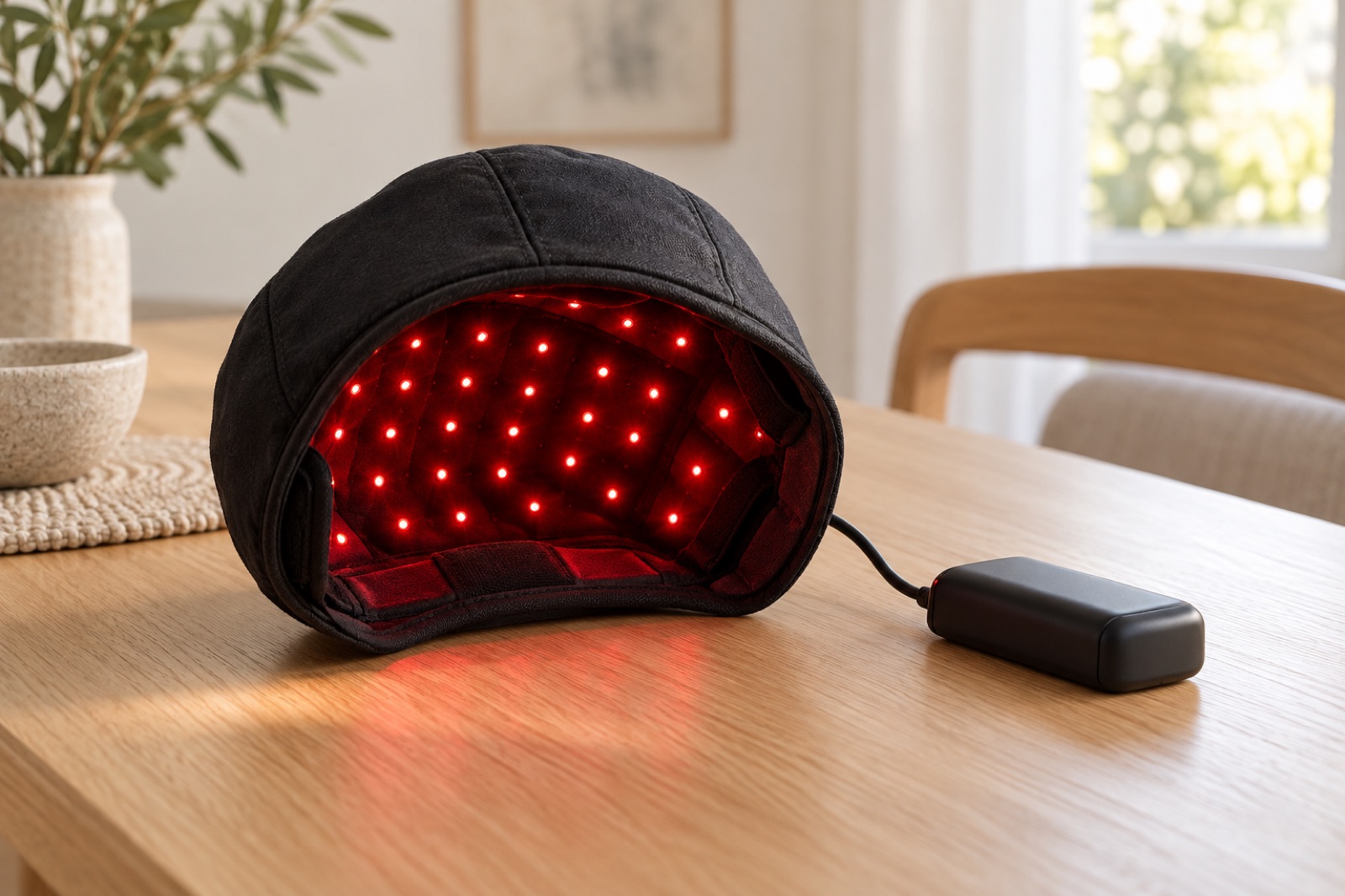
Shopping for a laser cap for hair growth can feel like comparing numbers without knowing which ones matter. One device advertises hundreds of diodes; another emphasizes its wavelength or short sessions. The most useful question is whether a device has clear specifications, fits your scalp and routine, and comes with terms you can live with while you assess results over months.
Low-level light has been studied mainly for androgenetic alopecia, also called pattern hair loss. It has not been shown to address every cause of thinning. If your hair loss is sudden, patchy or painful, see a doctor rather than relying on a light device to explain what is happening.
Key takeaways
- Both laser and LED devices have shown benefits over sham devices in studies, but the studies listed here do not establish which light source is better.
- Diode count describes light-emitting points. Check coverage, fit and instructions alongside the count.
- Expect a routine measured in months. Results vary, and a return window may end before you can judge changes in your hair.
- Read the warranty, return conditions and device instructions before buying.
What does the research actually show?
Controlled studies provide a reason to consider low-level light for pattern hair loss, though they cannot tell you how well any particular cap will work for you. In a 16-week trial in 44 men, Lanzafame and colleagues tested a helmet combining 21 lasers and 30 LEDs at 655 nm. Participants used it every other day for 25 minutes. Hair counts rose more with the active helmet than with an identical-looking sham unit.
A separate 24-week trial in 40 people tested an LED helmet emitting at 630, 650 and 660 nm for 18 minutes daily. Kim and colleagues reported greater improvements in hair density and diameter with the active device than with sham. In a 24-week trial in 100 people, Fan and colleagues compared active light on one side of the head with sham light on the other, using 30-minute sessions three times a week. The treated side showed greater gains in hair count, thickness and coverage.
A meta-analysis of 11 double-blind randomized trials found increased hair density versus sham in men and women, with both comb-type and helmet-type devices. The authors also noted substantial differences among trials. Many device studies were funded by manufacturers, and results from one device do not automatically transfer to another with different settings. Read the findings as support for considering the category, not a prediction for a specific purchase. For more context, see red light therapy for hair loss: what the evidence says.
Laser vs LED hair growth devices
Laser diodes emit a narrow, coherent beam. LEDs emit a broader, non-coherent spread of light. That distinction describes how the light is produced; by itself, it does not tell you which cap will lead to a better hair outcome.
Both types appear in positive sham-controlled research. The Lanzafame helmet combined lasers and LEDs, while the Kim helmet used LEDs. None of the studies cited here compared an otherwise equivalent laser cap directly against an LED cap. A claim that lasers always outperform LEDs, or that LEDs always outperform lasers, goes beyond this evidence.
If you are comparing a red light cap for hair growth with a red light helmet for hair growth, ask the seller to identify the light sources and specifications of the exact model. Look at the whole design and the routine it requires, rather than treating the word “laser” as an outcome guarantee.
Wavelength: useful to know, easy to overread
Caps and helmets in hair studies mostly emit red light around 630–680 nm. A few products add near-infrared light. A wavelength listing helps you see what a device emits and whether it resembles light used in research. It does not show that two devices with the same listed wavelength deliver the same light to the scalp or will produce the same result.
Check whether the seller states the wavelength for each light source, especially if the device mixes lasers and LEDs. Be cautious when a listing presents a wavelength as proof of superior regrowth without showing how the complete device was studied.
Diode count: more light points, not a growth forecast
A diode count tells you how many light-emitting points a cap has. It does not tell you how much hair it may help grow. Output per diode, wavelength, placement, coverage and consistent use also matter. A larger number can be helpful when comparing layouts, but it cannot stand in for information about those other features.
Look for a clear view of where the diodes sit. Does the layout cover the areas you want to address, such as the top, crown or front of the scalp? Ask what changes between models with different counts. If the answer is simply that the largest count guarantees the best result, treat that as a marketing claim rather than a conclusion supported by the trials above.
Coverage and fit matter in daily use
A cap is hands-free and covers the top of the scalp at once. A handheld comb must be moved slowly across the scalp, which asks more of you during each session. A set of four sham-controlled laser comb trials reported greater gains in terminal hair density with active combs used three times a week for 26 weeks. The choice between a comb and a cap can therefore come down partly to which routine you can keep.
For a cap or helmet, check its dimensions, adjustment options and the areas its lights face. A cap that sits snugly keeps its diodes close to the scalp. Consider your hair length and styling when judging whether the lights can reach the areas you want covered. Product photographs taken only from the outside may not answer that question; an interior view is more useful.
Comfort also affects consistency. Consider the device’s weight, how it feels at the forehead and whether it stays in place while you sit or move around. If you plan to wear a cap discreetly, check whether the manufacturer says it can be worn under a hat and whether doing so fits its instructions.
Session length and schedule
Protocols in the cited trials ranged from 18 to 30 minutes per session, from daily use to every other day or three times a week, over 16 to 26 weeks. Those are descriptions of specific studies, not a schedule to apply to every device. Follow the instructions for the model you buy.
Before purchasing, calculate how the prescribed sessions will fit into an ordinary week. A hands-free cap may suit someone who wants to sit and read during a session; a comb requires time and attention to move it across the scalp. A timer with automatic shutoff can remove the need to watch the clock. Longer sessions than the instructions specify should not be assumed to bring faster results.
Results vary and may take months to assess. If you do see gains, stopping use may let them fade. Think about whether the ongoing schedule is realistic for you, not just whether you can manage it during the first week.
Battery, warranty and returns
If you want to move around during a session, find out whether the cap is cordless, how its battery pack is worn and whether it is included. Cordless use can make a 20–30 minute routine easier to fit around daily life. Also check how the device charges and whether a replacement battery or other parts are available under the seller’s terms.
Read the warranty for its length, what it covers and what you would need to do if the device stopped working. Then read the return policy separately: note the deadline, the condition in which a return is accepted and any costs you would pay. A trial that assesses hair after several months does not mean a shop offers a return window that long. Know the dates before placing an order.
Quick comparison checklist
| Spec | What to look for | Why it matters |
|---|---|---|
| Light source and wavelength | Lasers, LEDs or both; stated wavelengths | Lets you understand what the device emits |
| Diode layout and fit | Interior view, covered areas and size adjustment | Shows where the light points face when worn |
| Session schedule | Clear instructions and an automatic timer | Helps you plan consistent use |
| Power and comfort | Battery arrangement, weight and hat compatibility | Shapes how easily it fits your routine |
| Purchase terms | Written warranty and return conditions | Sets out your options if the device does not suit you |
Marketing claims to question
Be wary of guaranteed regrowth, claims to “cure” hair loss, or suggestions that more minutes will necessarily bring faster results. Look closely at before-and-after photos: different lighting, angles or styling can make a change hard to judge. A seller that gives no return policy leaves you with less information about the purchase itself.
When a page names a study, check which device and schedule it tested. A favorable result for a helmet, LED device or comb is not automatically evidence for a cap with different settings. You can see how we summarize the research and compare any claims you encounter with the published studies.
Making a choice
Start with the areas you want covered and the routine you are willing to keep. Compare the specifications and purchase terms for the exact models on your shortlist. The ReHair laser cap, for example, comes in 88, 160 and 272 diode versions in the same hands-free format; those counts describe light-emitting points, not promised levels of growth. Whichever device you consider, give fit, instructions and return terms as much attention as its headline number.
FAQ
Do laser caps for hair loss work for everyone?
No. Low-level light has been studied for androgenetic, or pattern, hair loss, and results vary. Sudden, patchy or painful hair loss needs a doctor’s assessment.
Are laser caps better than LED helmets?
The studies cited here include positive sham-controlled results for devices using lasers, LEDs or both. They do not provide a head-to-head comparison that proves one light source is better.
Does a higher diode count mean better results?
No. It tells you how many light-emitting points a device has, while output per diode, wavelength, layout, coverage and consistent use also matter.
How long should I use a red light cap for hair growth?
Follow your device’s instructions. The cited trials used sessions of 18–30 minutes on schedules ranging from daily to three times a week, with outcomes assessed over 16–26 weeks; those protocols are specific to the devices tested.
What should I check before buying a cap?
Check the light source and wavelength, interior diode layout, fit, required schedule, battery arrangement, warranty and return terms. Choose a routine you can realistically follow for months.


