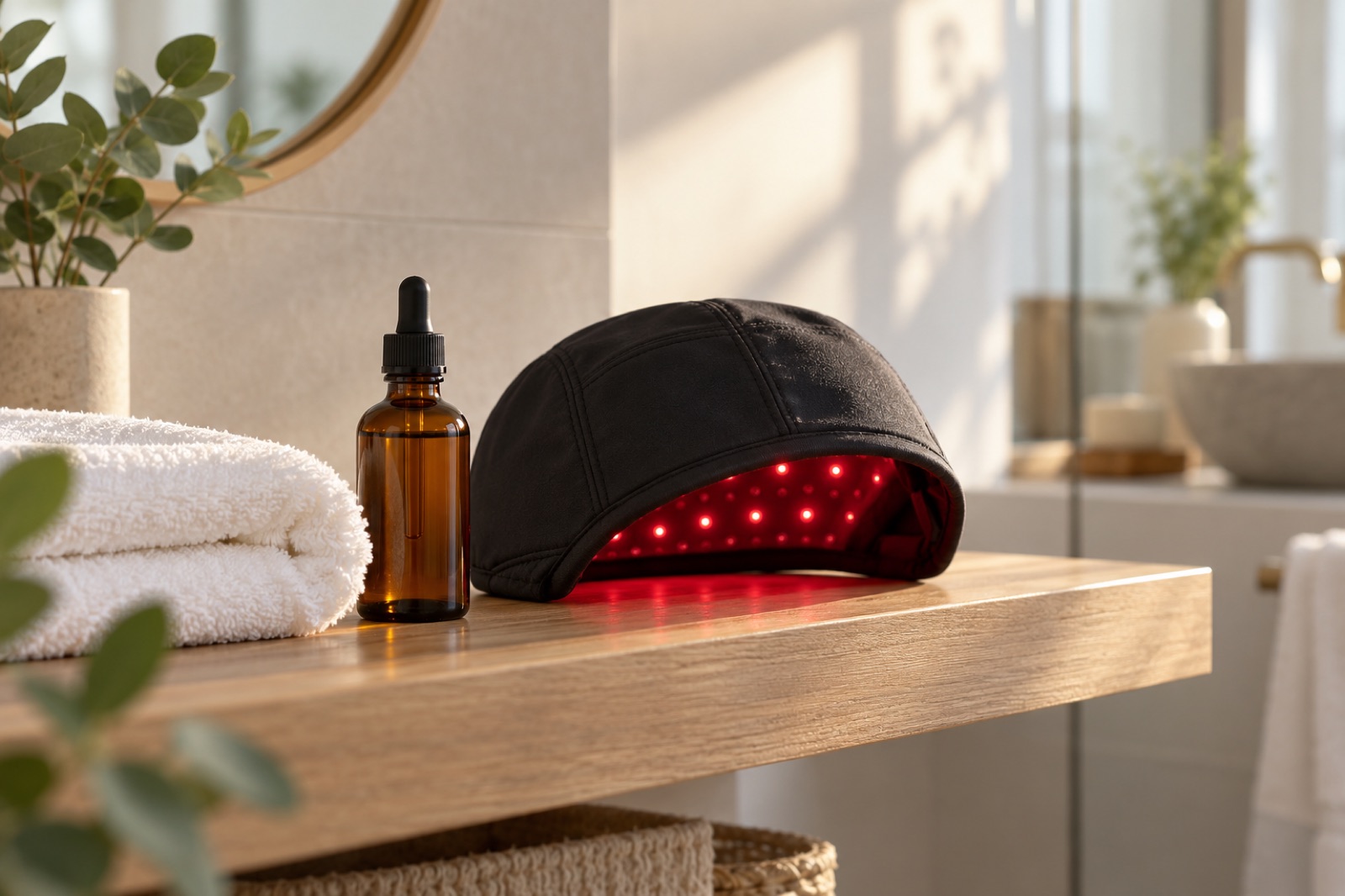
If you use minoxidil or are considering it, you may wonder whether adding red light therapy could help. The two approaches work differently, and some studies have tested them together. Their results are mixed: some report added improvement, while others find no meaningful advantage over minoxidil alone.
That leaves a practical question: is it reasonable to use both, and how might you fit them into a routine? The answer depends on your hair loss, the product instructions and your willingness to stick with a routine for months. The evidence does not establish that combining them works better for everyone.
Key takeaways
- Minoxidil is an established over-the-counter medicine for pattern hair loss. Low-level light is a non-drug option studied for androgenetic, or pattern, hair loss.
- Combination studies have mixed results, and two 2025 meta-analyses reached different conclusions.
- Use a light device as its instructions direct. Many are intended for a clean, dry scalp; one trial used light first and minoxidil afterwards.
- Allow at least 4–6 months to judge a routine, and take comparison photos in the same lighting every four weeks.
- Sudden, patchy or painful hair loss needs medical advice because it can have causes that these approaches are not designed to address.
What minoxidil and red light do
Topical minoxidil is an over-the-counter medicine for pattern hair loss. It is sold in 2% and 5% solutions and 5% foam. In a 48-week trial in men, 5% minoxidil performed better than 2% and placebo on hair counts and ratings from patients and investigators; responses appeared earlier with 5%. In a trial in women, both 2% and 5% performed better than placebo on hair counts, while 5% caused more itching, irritation and unwanted facial hair.
These trials support minoxidil as a medicine people may consider for pattern hair loss. It has to be used continuously to maintain its effects. Extra shedding can happen during the first weeks. Follow the product label and speak with a clinician or pharmacist if you are unsure whether it is suitable for you.
Low-level light therapy uses red light, commonly around 630–680 nm, delivered through devices such as caps, helmets, combs or brushes. It is a non-drug option studied for androgenetic alopecia, the medical term for pattern hair loss. Evidence for this use does not mean it is appropriate for every cause of thinning.
For an overview of the light research, see red light therapy for hair loss: what the evidence says. People considering minoxidil for women can also read about treatment choices in hair loss treatment for women.
What combination studies found
Researchers have compared minoxidil alone with minoxidil plus low-level light, but the trials differ in their participants, devices, schedules and follow-up periods. Several were small, and some light-therapy trials were funded by device makers. Results from one device or protocol do not automatically apply to another.
| Study | Who | What was compared | Result |
|---|---|---|---|
| Esmat et al., 2017 | 45 women with female pattern hair loss; 4 months | 5% minoxidil twice daily, an LLLT helmet three times weekly, or both | Minoxidil and light had comparable results; the combination group scored best on Ludwig grade and satisfaction. |
| Faghihi et al., 2018 | 50 people aged 17–45; 12 months | 5% minoxidil with an active light comb or a switched-off comb | Hair density, hair diameter and satisfaction were higher with active light. The authors noted small sample size and adherence limitations. |
| Ferrara et al., 2021 | 21 men; 6 months | Light on one half of the scalp, followed by minoxidil on the whole scalp twice daily | Both sides improved, with no significant difference between the light-treated and comparison sides. |
| Sondagar et al., 2023 | 54 people with androgenetic alopecia; 16 weeks | LLLT twice weekly plus 5% minoxidil, or 5% minoxidil alone | Hair density improved in both groups; the difference between groups was not statistically significant. |
| Alosaimi et al., 2025 | Meta-analysis of 4 randomized trials | Minoxidil alone compared with minoxidil plus LLLT | Found no significant difference in hair counts or hair diameter. |
| Mawu et al., 2025 | Meta-analysis of 7 randomized trials | Minoxidil alone compared with minoxidil plus LLLT | Reported greater increases in hair density and diameter, and higher satisfaction with the combination; differences between trials were moderate. |
The two 2025 meta-analyses are especially relevant because they combine results across trials, yet they do not reach the same conclusion. One found no significant added benefit; the other reported better outcomes with the combination. The underlying studies varied, so neither summary guarantees what an individual will experience.
Overall, the research gives a reason to study the combination further, but not a clear answer that red light adds a worthwhile benefit for every person already using minoxidil. A modest trial result, or a result from one device, should not be treated as a promise about a different device or routine.
For details on how research is reviewed and summarized, see how we summarize the research.
Can you use red light therapy with minoxidil?
Some people may reasonably consider using both if their hair loss is consistent with pattern hair loss, they can follow the instructions for both products and they understand that extra benefit is uncertain. Minoxidil has an established role as an over-the-counter medicine for pattern hair loss; light is an additional option, not a replacement for minoxidil.
There is no single timing schedule established by the studies for all devices and minoxidil products. Many light devices are intended for use on a clean, dry scalp. In the half-head trial by Ferrara and colleagues, light was used first and minoxidil was then applied to the whole scalp. That study’s sequence does not prove it is the right order for every device or product.
- Read the instructions for both products and use the light device only for the stated session length and schedule.
- If you plan to use red light after applying minoxidil, check the device and medicine instructions first. If they do not address timing, ask a pharmacist or dermatologist.
- Do not extend light sessions in the hope of getting faster or greater results. Using light longer than the device instructions say has not been shown to work better.
- Give a routine at least 4–6 months before judging it, unless you have a concerning reaction or a clinician advises you to stop. Take photos every four weeks in the same light and from the same angles.
Consistency can be difficult, so a routine that fits your day matters. Minoxidil needs ongoing use, and light devices have their own schedules. If either routine feels impractical, a healthcare professional can help you weigh the options.
Minoxidil safety and when to seek advice
Anyone who is pregnant, breastfeeding or has heart problems should ask a doctor before using minoxidil. Stop using it and get medical advice if warning side effects listed on the product label occur, such as chest pain, a rapid heartbeat or dizziness. Other irritation or unwanted effects are also reasons to check the label and seek advice from a pharmacist or clinician.
Talk with a healthcare professional if you are unsure what is causing your hair loss or which option suits you. Low-level light has been studied for androgenetic, or pattern, hair loss; that evidence does not cover every cause. Sudden, patchy or painful hair loss needs a doctor, since it may need a different assessment.
Results vary, and gains from either approach can fade when treatment stops. If you are considering a home device, focus on whether its directions fit your routine and whether you can use it consistently. ReHair’s laser cap is one at-home light-device option; its listing describes versions with 88, 160 or 272 diodes.
This article is general information, not medical advice. For more on the evidence and the limits of these studies, consult the linked research and speak with a healthcare professional about your situation.
FAQ
Can you do red light therapy after applying minoxidil?
Timing depends on the instructions for your light device and minoxidil product. Many light devices are intended for a clean, dry scalp, and one trial used light first followed by minoxidil; if the instructions do not explain the order, ask a pharmacist or dermatologist.
Will red light therapy regrow lost hair?
Studies have examined low-level light for androgenetic, or pattern, hair loss, but results vary and do not establish that it will regrow hair for everyone. Sudden, patchy or painful hair loss needs a doctor because it may have another cause.
Is 30 minutes of red light therapy too much?
There is no one session length that applies to every device. Follow the instructions for your device; using light longer than directed has not been shown to work better.
Does adding red light make minoxidil work better?
Combination studies have mixed findings: some reported improvement with both, while others found no significant added benefit over minoxidil alone. The two 2025 meta-analyses also disagree, so added benefit is uncertain.
How long should I try both before judging results?
Judge a routine over at least 4–6 months, unless a concerning reaction means you should stop and seek advice. Taking photos every four weeks in the same lighting can help you compare changes.


