A laser comb for hair growth can look like a straightforward way to care for thinning hair at home. The harder questions are whether the evidence applies to your hair loss, how carefully you need to use the device, and whether you can keep up the routine.
Studies of low-level light devices have reported improved hair density in people with androgenetic alopecia, also called pattern hair loss. That does not mean every comb will give the same result. The device, schedule, and cause of thinning all matter.
Key takeaways
- Know the type of hair loss. Low-level light has been studied for pattern hair loss, not every cause of shedding or thinning.
- Cover the full area. A comb takes slow, deliberate passes over the thinning scalp at each session.
- Allow time. Expecting a visible change after only a few weeks can make it hard to judge a consistent routine.
- Choose a format you will use. A comb is portable and usually costs less; a cap covers the top of the scalp with less hands-on effort.
What is a laser comb?
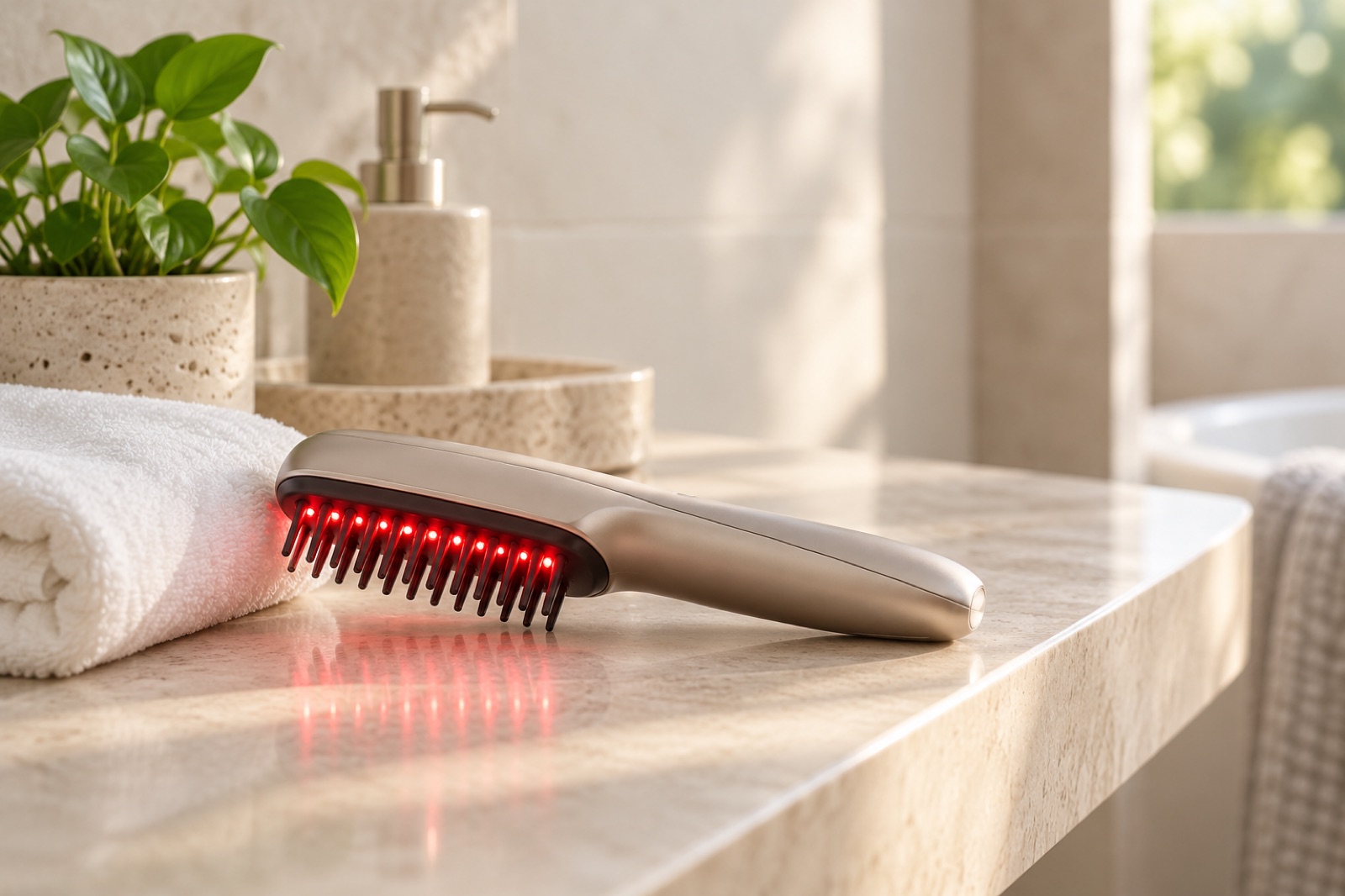
A laser comb is a handheld device with a row of low-power red laser diodes, sometimes alongside LEDs. Its teeth part the hair as you move it, helping light reach the scalp beneath. It does not work like a styling comb: simply drawing it quickly through the hair misses the slow, even coverage called for in comb protocols.
Low-level light devices come in several shapes, including combs, brushes, and caps. A comb lets you guide the light across a particular area. That control comes with a practical trade-off: you must hold it, move it, and pay attention to where it has been.
If you are exploring the broader category, our guide to red light therapy for hair loss: what the evidence says puts combs alongside other light-based devices.
Does a laser comb work?
There is evidence that some laser combs may help increase hair density in people with pattern hair loss. In Jimenez et al., 2014, four randomized, sham-controlled, double-blind trials studied HairMax Lasercomb models with 7, 9, or 12 beams in men and women. Participants used a comb three times a week for 26 weeks. Terminal hair density increased more with the active combs than with the sham devices.
The HairMax Lasercomb is named here because it was the device studied. The main comb trials were sponsored by the device maker, which is useful context when weighing the findings. They also tested particular models under a particular protocol. Their results cannot be assumed to apply equally to every laser comb or to someone using a different schedule.
A 2019 meta-analysis by Liu et al. pooled 11 double-blind randomized trials of low-level light devices. It found greater hair density with active devices than with sham devices in men and women, including studies of comb-type and helmet-type devices. The authors noted substantial differences among the trials, so the pooled finding does not tell you exactly what to expect from an individual product.
Evidence for wearable devices helps put the comb findings in context. In a 2013 trial by Lanzafame et al., 44 men used a helmet containing 21 lasers and 30 LEDs at 655 nm every other day for 25 minutes over 16 weeks. Hair counts rose more with the active unit than with a matching sham unit. A 2014 trial in 47 women using the same design also reported a greater rise in hair counts with the active unit over 16 weeks; the study reported no adverse events.
These studies support a cautious answer to “does a laser comb work?”: low-level light may help some people with pattern hair loss, and comb trials have reported gains compared with sham use. Results vary. The helmet findings support the wider device category, but they do not establish that a comb and a cap will produce identical results for you.
Who is the research relevant to?
The evidence discussed here concerns androgenetic alopecia, often called male or female pattern hair loss. It commonly develops gradually, though a change in your hair can have more than one possible cause. A device cannot tell you why your hair is thinning.
If hair loss is sudden, patchy, painful, or accompanied by signs of scalp scarring, speak with a doctor. Low-level light has not been established by these trials for those patterns of hair loss. It also makes sense to seek medical advice if you are unsure what is behind a new change, since the best next step depends on the cause.
How to use a laser comb
Your device’s instructions set its session length, pace, and schedule. The steps below describe a careful general approach and the care needed to avoid gaps in coverage; follow your own device’s directions wherever they differ.
- Start with a clean, dry scalp. Make sure hair or styling residue is not unnecessarily blocking the area you intend to cover. Check the device instructions before using it with any product on your scalp.
- Map the whole thinning area. Think beyond the single spot you notice most in the mirror. Work out a route that reaches the front, crown, or other affected parts that the comb can cover.
- Part the hair with the comb teeth. Keep the device positioned as its instructions describe so the light can reach the scalp rather than sitting above a layer of hair.
- Make slow passes from front to back. Move across the area methodically, pausing a few seconds at each spot if that matches your device’s directions. Shift to an adjacent line and continue until you have covered the area.
- Check coverage from side to side. Use side-to-side passes to catch areas you may have skipped. The aim is consistent coverage of the full thinning area at every session, within your device’s prescribed session length.
- Keep a repeatable schedule. The comb trials used devices three times a week. Follow the schedule for your own device and consider using the same days each week so sessions are easier to remember.
- Protect your eyes. Do not look into the light. Follow all eye-safety and positioning instructions supplied with the device.
There is no universal number of minutes or fixed hold time that suits every comb. The trial schedule is useful context, but the tested protocol does not replace the directions for another model. More time in one spot is not a substitute for reaching all the areas you intended to cover.
Common mistakes that make a comb harder to assess
- Moving too fast. A quick pass may leave too little time over each part of the scalp compared with the pace your device calls for.
- Skipping sections. Without a route, it is easy to revisit one line and miss the next. Consistent front-to-back and side-to-side coverage helps.
- Using it only on the most visible spot. Check the entire thinning area you mean to cover rather than focusing only on the part that catches your eye.
- Stopping after a few weeks. The main comb trials ran for 26 weeks. A short attempt gives you little basis for judging whether a routine is worthwhile for you.
- Expecting a change before three to four months. Visible changes can take time, and some people may see little change. Try to judge progress against the same lighting and hairstyle rather than a different photo or mirror angle each time.
Any gains may fade after use stops. That makes the effort of regular sessions part of the decision before you buy, not just something to think about once a device arrives.
Laser comb vs laser cap
Both formats deliver low-level light, but they ask different things of the person using them. A comb gives you direct control over its path. A cap sits over the top of the head and covers that region at once. Coverage still depends on the device’s fit and the area you want to reach.
| Consideration | Laser comb | Laser cap |
|---|---|---|
| Cost | Generally the less expensive format | Generally the more expensive format |
| Effort | Requires your hands and attention throughout the session | Hands-free during use |
| Coverage | You guide it across each part of the thinning area | Covers the top of the scalp at once, subject to fit |
| Session time | Depends on the device and the area covered | Depends on the device; no manual passes needed |
| Consistency | Depends on repeating the same careful route | May be easier to keep up if manual sessions feel burdensome |
| Travel | Small and easy to pack | Bulkier to pack |
A comb may suit you if a lower upfront cost matters, you travel often, or you prefer guiding a device over the areas you can see. Be honest about whether you have the time and attention for slow passes at every session. The convenience of a small device matters less if its routine does not fit your week.
A cap may suit you if thinning extends across the top of your scalp and you would find hands-free sessions easier to repeat. Check the fit, coverage area, and instructions for any cap you consider. Neither format removes the need for patience: results vary, and the studies above do not provide a reliable head-to-head prediction for an individual buyer.
For examples of the two formats, you can view the ReHair handheld laser comb and ReHair laser cap. The published studies cited here tested specific research devices; they should not be read as direct trial results for these products. You can also read how we summarize the research.
FAQ
How often should I use a laser comb?
The main comb trials used the studied devices three times a week for 26 weeks. Use the schedule in your own device’s instructions, and keep it consistent.
How long should I hold a laser comb in one spot?
Move slowly and pause a few seconds at each spot if your device’s instructions call for that approach. Session length and pace depend on the model, so follow its directions while covering the full thinning area.
When might I notice a change?
A few weeks is generally too soon to judge the sort of routine studied in the comb trials. Avoid expecting a visible change before three to four months, and remember that results vary.
Is a laser comb better than a laser cap?
Neither is clearly better for everyone. A comb is portable and gives you control but requires careful manual coverage; a cap covers the top of the scalp hands-free and may be easier to use consistently.
Can I use a laser comb for sudden or patchy hair loss?
The studies discussed here concern pattern hair loss, not sudden, patchy, or scarring hair loss. See a doctor if loss is sudden, patchy, painful, or associated with signs of scarring.


