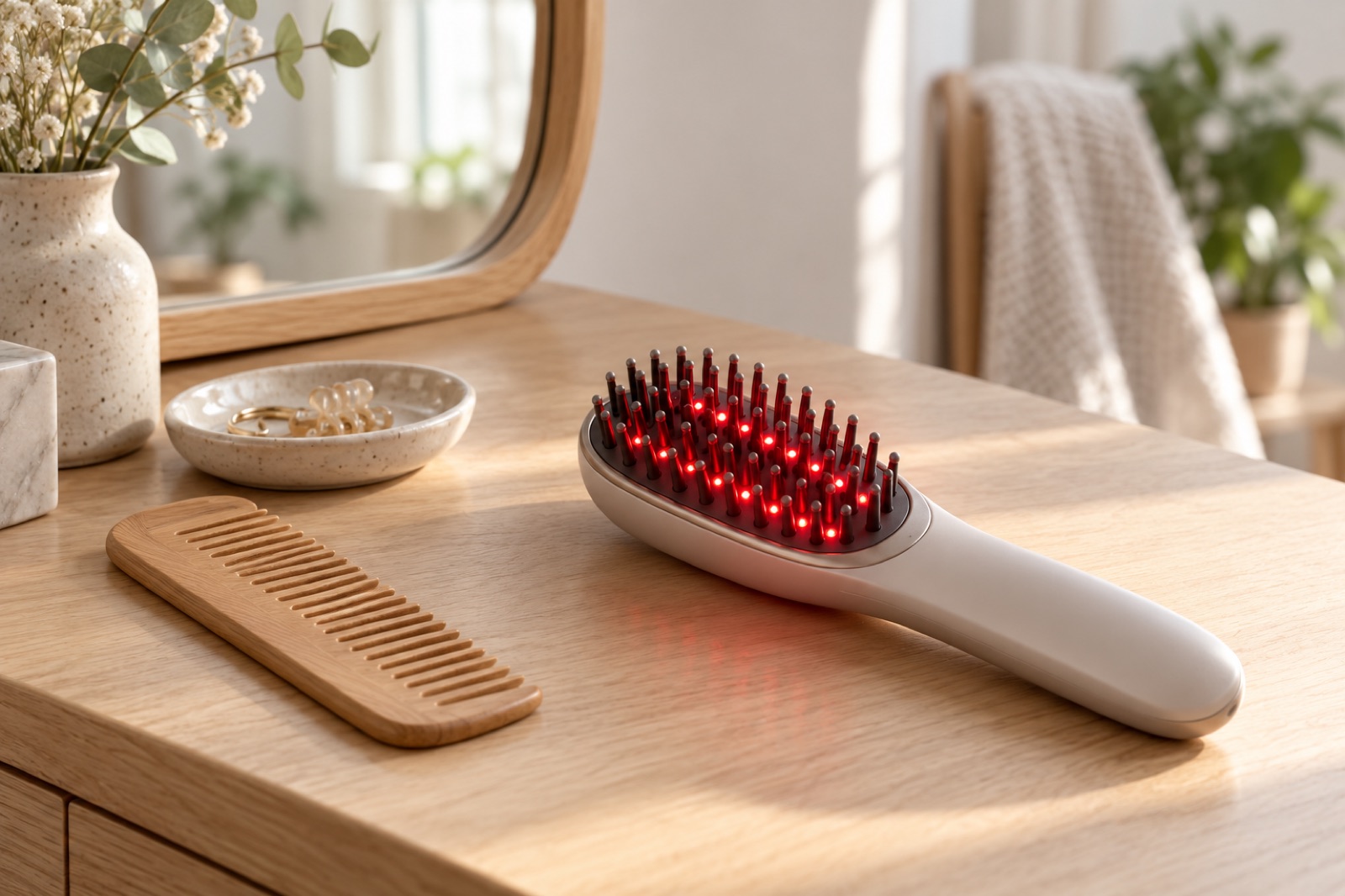
A red light therapy hair brush is a handheld device that places red LEDs or laser diodes between or along its bristles. Some models also add vibration, heat, “EMS” or “microcurrent,” or a reservoir for hair serums. Those extras can make a listing look more advanced, but the evidence for them is not the same as the evidence for low-level light therapy.
Research has looked mainly at low-level light devices such as laser combs, caps, and helmets used regularly over several months. That research is about androgenetic alopecia, also called pattern hair loss. It does not show that a red light brush can help every kind of shedding or scalp problem.
Key takeaways
- Some controlled studies of low-level light devices reported increased hair density compared with sham devices, but study results do not automatically apply to every brush.
- Evidence for vibration, “EMS,” microcurrent, heat, and serum reservoirs as hair growth features is limited or absent in the published research cited here.
- Check that a listing states its light source, wavelength, and clear session instructions. A red glow alone does not show what the device delivers.
- Brushes and combs need manual passes over the scalp; caps are hands-free. Choose a format you can use consistently.
What a red light brush is—and what the light evidence shows
These brushes are designed to bring a light source close to the scalp while you move the device through the hair. The light may come from LEDs, laser diodes, or both. Red light is a broad marketing description, so it does not tell you the source, wavelength, or output of a particular device.
In a 2014 report, Jimenez and colleagues described four multicenter randomized, sham-controlled trials of a laser comb. Men and women used it three times a week for 26 weeks. Terminal hair density increased more with the active comb than with the sham device. Read the study summary on PubMed.
A 2019 meta-analysis by Liu and colleagues reviewed 11 double-blind randomized trials. It reported higher hair density with low-level light therapy than with sham, in men and women and in comb-type and helmet-type devices. The authors also noted that the trials differed substantially from one another. Read the meta-analysis on PubMed.
One randomized, double-blind study of 44 men tested a helmet using 655 nm laser and LED light every other day for 25 minutes over 16 weeks. Hair counts increased more than with an identical-looking sham unit at a measured transition-zone site. Read the study on PubMed.
These findings offer some support for low-level light as an option that may help people with pattern hair loss. They do not prove that every product marketed as a red light brush works, or that the results from a studied comb or helmet will transfer to a different device. Many light-therapy trials were small, and some were funded by device makers. Results vary, and gains can fade when treatment stops.
Do the brush add-ons help?
There are few or no published controlled trials in the research summarized here for the add-on features found on many lower-cost brushes. That includes vibration, “EMS,” “microcurrent,” heat, and serum reservoirs. Their presence is not evidence that they improve hair growth.
Scalp massage has limited evidence of its own. A small study followed nine healthy Japanese men who used a scalp massage device for four minutes daily for 24 weeks. Average hair thickness increased, but the study had no control group and was very small. It cannot establish that massage caused the change, or that brushing or massage will increase hair growth generally. Read the study on PubMed.
Brushing can help arrange hair or distribute products, but forceful brushing can pull on strands and irritate the scalp. A massage feature may feel pleasant; treat that as a comfort feature unless a specific claim is supported by suitable evidence.
How to compare a red light brush listing
Some low-cost listings do not state a wavelength or output. Some devices may only glow red for show, so check the product details instead of judging by appearance, photographs, or the word “laser” in a title. Use this checklist to compare what a seller actually tells you.
| What to check | Why it matters | What to look for |
|---|---|---|
| Light source | “Red light” does not identify how light is produced. | A clear statement of whether the device uses LEDs, laser diodes, or both. |
| Wavelength | Color alone does not specify wavelength. | A stated wavelength, rather than only a red glow or color description. |
| Light points | The layout helps you understand how the device meets the scalp. | A clear description or image showing the number and placement of light points. Treat this as a comparison detail, not proof of effectiveness. |
| Session instructions | Studied devices were used on a schedule over weeks or months. | Specific guidance for session length, frequency, and how to move the device. |
| Timer | A timer can help you follow the stated session. | Instructions that explain how the timer works and when a session ends. |
| Warranty and returns | These terms affect how you can assess a purchase. | Written warranty duration, return window, conditions, and contact details. |
Some brushes and combs are marketed with FDA 510(k) clearance for pattern hair loss. Clearance is specific to a model; you can look up a named model in the FDA’s public 510(k) database. A broad marketing statement does not tell you whether a different model has clearance.
When comparing claims, ask what evidence supports that exact device and its instructions. A study of one laser comb does not establish the performance of every LED brush, and a listed diode count alone cannot answer whether a device is suitable for you.
How to use a light brush or comb
Follow the instructions supplied with the specific device. A common approach described for these devices is to start with a clean, dry scalp, part the hair so the light can reach the scalp, and move the brush slowly across the whole thinning area. Follow the device’s session length and schedule, and avoid looking into the light.
Consistency matters because the studies used repeated sessions for 16 to 26 weeks. That does not mean the same schedule fits every product. Do not extend sessions or use a device more often than its instructions recommend. If the light causes discomfort or your scalp becomes irritated, stop and seek appropriate advice.
For step-by-step guidance on a comb format, see how to use a laser comb. For a broader discussion of the evidence, read red light therapy for hair loss: what the evidence says.
Brush vs. comb vs. cap
A brush or comb is portable and often costs less than a cap, but you have to make manual passes. It can take attention to cover the whole scalp evenly, and the crown can be awkward to reach. A cap is hands-free during a session, though it may cost more and needs to fit your routine.
The research summarized above includes both comb-type and helmet-type devices, but their findings do not make all models interchangeable. Compare the instructions and evidence for the exact device you are considering. For cap-specific shopping questions, see how to choose a laser cap.
If you prefer a handheld format, the ReHair handheld LLLT laser brush is one option to compare against the checklist. If you would rather use a hands-free format, the ReHair laser cap is another. Read the instructions and purchase terms for the model you are considering.
Who might consider one—and when to get medical advice
Low-level light therapy has been studied for androgenetic, or pattern, hair loss. It has not been established here as an answer to every cause of thinning. Sudden, patchy, or painful hair loss needs a doctor, since the cause may need assessment. This article is general information, not medical advice.
If you are weighing a device, consider whether you are comfortable following its schedule for months and whether its listing gives enough detail to make an informed comparison. Keep expectations measured: studies reported results under particular conditions, individual results vary, and any gains may fade after stopping use.
FAQ
What will red light therapy do for my hair?
Studies of some low-level light devices reported increased hair density compared with sham devices in people with pattern hair loss. Results vary, and the findings do not establish that every red light brush will have the same effect.
Does a red light brush work?
Some evidence supports low-level light devices, including laser combs and helmets, for pattern hair loss. A brush’s actual light source, wavelength, and instructions matter, and evidence for the add-on features on many brushes is limited or absent in the studies discussed here.
Can scalp massage increase hair growth?
One small uncontrolled study found increased average hair thickness after participants used a massage device daily for 24 weeks. Because it included only nine men and had no control group, it is weak evidence and cannot show that massage caused the change.
Does brushing hair actually stimulate hair growth?
The evidence summarized here does not show that ordinary brushing stimulates hair growth. A small massage-device study is not enough to establish that brushing or massage causes growth, and forceful brushing can pull on hair or irritate the scalp.
How long should I use a red light brush?
Use the session length and schedule in the instructions for your specific device. Studies used repeated sessions over 16 to 26 weeks, but their protocols do not set the right schedule for every product.


