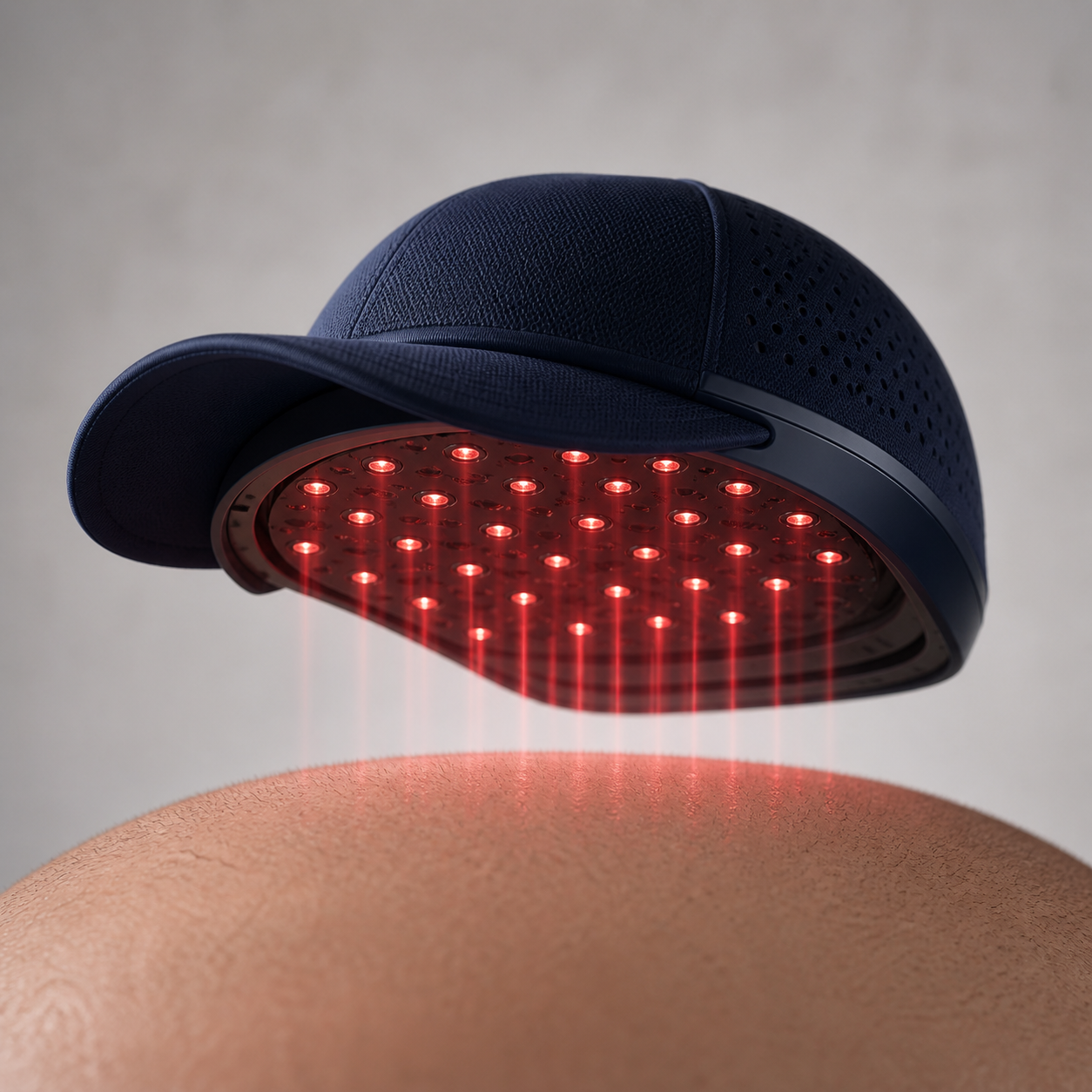
If you are noticing a wider part or a thinner crown, red light therapy for hair loss can sound appealing: use a device at home and see whether your hair improves. The useful question is narrower. Does low-level light help people with your kind of thinning, and what would a fair trial look like?
Key takeaways
- Studies have reported improved hair counts or density in some adults with androgenetic alopecia, also called pattern hair loss.
- Results vary. The research does not establish that every home device will produce the same results.
- Give a device at least 16 to 26 weeks of consistent use before judging changes, and compare photos taken every four weeks.
- Sudden, patchy or painful hair loss needs medical assessment rather than a trial of light therapy.
What is red light therapy for hair loss?
The treatment studied for hair is usually called low-level light therapy, or LLLT. You may also see it called photobiomodulation or low level laser therapy for hair loss. Devices deliver low-power red light, commonly around 630 to 680 nanometers, and some use near-infrared light. At these levels, the light is intended to reach the scalp without heating or cutting tissue.
Researchers are still studying how it might affect follicles. One proposed explanation is that light absorbed by mitochondria in follicle cells may increase cellular energy and blood flow, helping shift follicles toward the growth, or anagen, phase. That is a proposed mechanism, not proof that a particular device will make hair grow for a particular person.
The type of hair loss matters. The studies discussed here concern androgenetic alopecia: gradual male or female pattern thinning. They do not establish benefits for alopecia areata, scarring alopecia, or hair loss related to illness, medication or a deficiency. If you do not know why your hair is thinning, identifying the cause is a sensible first step.
Does red light therapy work for hair?
There is encouraging evidence for some people with pattern hair loss. In a 24-week randomized trial in men, a 655 nm laser and LED device produced a significant increase in hair counts compared with a sham device. A similar trial in women also reported a significant increase in hair counts versus sham. Both were reported by Lanzafame and colleagues in 2013 and Lanzafame and colleagues in 2014, respectively.
Evidence is not limited to one device shape. Jimenez and colleagues’ 2014 multicenter trials studied a laser comb in men and women. Terminal hair density increased more in participants using the active comb than in those using a sham device. Terminal hairs are the thicker hairs researchers can count when assessing density.
A 2019 systematic review and meta-analysis by Liu and colleagues combined randomized trials and concluded that low-level light therapy increased hair density versus sham in adults with androgenetic alopecia. The authors also noted differences between devices and treatment protocols.
Those findings support a cautious answer: red light therapy for thinning hair may help some people with pattern hair loss. They do not tell us that everyone will notice a cosmetic difference. A change in measured hair density and a change you can see in the mirror are related, but they are not identical goals.
What are the limits of the evidence?
Many trials were funded by device makers. That does not erase their results, but it is a reason to read claims carefully and value comparisons with sham devices. The studies also tested specific devices with specific settings and schedules. A positive result for one cap, helmet or comb does not automatically apply to every product sold for home use.
Not everyone responds. Low-level light may be more useful during early to moderate pattern thinning, when follicles are still active. If an area has had little visible hair for a long time, it is reasonable to keep expectations modest. The research described here also does not provide a dependable way to predict an individual result before starting.
Think of this as a continuing routine rather than a course with a permanent finish line. If use stops, any gains may fade over time. That possibility belongs in the decision alongside the time a device requires each week.
Who might consider it, and who should see a doctor?
Someone with gradual pattern thinning who can follow a regular schedule may be a reasonable candidate for a trial. For example, a slowly widening part or a gradually thinning crown fits the pattern addressed in the studies more closely than a sudden change in shedding. A clinician can help confirm the cause if it is unclear.
Sudden, patchy or painful hair loss needs a doctor. So does a scalp change that worries you or thinning that began around an illness, medication change or possible deficiency. Light therapy has not been established for every cause of hair loss, and using a device cannot identify what is driving a new symptom.
If you are already discussing hair loss with a clinician, ask how a home light device might fit into your overall plan. The most useful decision starts with knowing what kind of hair loss you have, what you hope to see change, and whether you can maintain the routine long enough to assess it.
How long does red light therapy for hair growth take?
Expect months, not days. The trials described above ran for 16 to 26 weeks. When a person does respond, shedding may slow before a visible change in density appears. Day-to-day checks are unlikely to show a clear trend, especially when lighting, styling and hair length change how much scalp you can see.
Before starting, take baseline photos of the areas you want to follow. Then take photos every four weeks from the same angles, with similar lighting, part placement, hair condition and distance from the camera. If you need a reminder of the setup, see how to take consistent progress photos. A short note about shedding and how consistently you used the device can add context.
Give the routine at least 16 to 26 weeks before making a judgment, unless a clinician advises otherwise or you develop a problem using it. At that point, compare the first and latest photos side by side. Look for a pattern across several images rather than deciding from one particularly good or bad hair day.
What can before and after photos show?
Red light therapy before and after photos can help you track your own experience, but they are easy to misread. A different part, a shorter haircut, damp hair or brighter overhead lighting can make the scalp appear more or less visible. Even honest photos may exaggerate a change when the setup varies.
Photos are most useful as a consistent personal record. Try to photograph the same part, crown or hairline each time and keep the originals. You can also note whether the change matters to you in ordinary conditions, such as how your hair looks when you style it as usual. A study’s measured hair count answers a different question from whether you feel your hair looks fuller.
Caps and combs: how do home devices differ?
Laser caps and helmets sit over the head and deliver light across the scalp while you wear them. They are hands-free and generally cover a broad area; designs can contain dozens to a few hundred diodes. A cap may suit someone who wants to follow a routine without moving a device over each thinning area.
Laser combs and brushes are handheld. You move them over the scalp during a session, which gives you direct control over where you spend time. They also ask more of your attention and technique. Coverage depends on moving the device as instructed rather than simply putting it on.
Neither format is automatically the better choice for everyone. Think about the areas you want to cover and whether you are more likely to keep up with a hands-free session or a handheld routine. The trials above included different device types, but their results cannot establish that all caps outperform all combs, or the reverse.
How do you give a device a fair trial?
- Start with the cause. Make sure gradual pattern thinning is a reasonable explanation. Seek medical advice for sudden, patchy or painful loss.
- Follow the device instructions. Home sessions are usually around 10 to 30 minutes, every day or every other day, depending on the device. Use its stated schedule rather than assuming more time means a better result.
- Record your starting point. Take photos before the first session, then repeat them every four weeks under similar conditions.
- Stay consistent long enough to assess it. Plan for at least 16 to 26 weeks. Note missed sessions so you can interpret your photos fairly.
- Review what changed. Compare photos and your own experience. Results vary, and a modest change may matter to one person more than another.
For someone comparing formats, the ReHair laser cap is available in 88, 160 and 272 diode versions, while the ReHair handheld laser comb offers a handheld option. Use the instructions for whichever device you choose. The research cited here should not be read as a clinical result for either of these products.
What about safety?
Side effects reported in studies were mild and uncommon, including scalp itching, tenderness or a warm feeling. Low-level light works at a power that does not heat or cut tissue, but comfort still matters. Follow the device’s instructions, including its directions for session length and use around the eyes.
If a session causes discomfort that persists, stop using the device and seek advice. And if your hair loss is sudden, patchy or painful, arrange a medical assessment even if you have already started a home routine. The main practical risk is spending months on a method studied for pattern thinning when something else may explain your symptoms.
FAQ
Does red light therapy work for hair loss?
Randomized trials and a review reported improved hair counts or density versus sham devices in some adults with androgenetic alopecia. Results vary, and the findings do not apply automatically to every device or cause of hair loss.
How long should I try red light therapy before judging it?
Plan for at least 16 to 26 weeks of consistent use, following your device’s instructions. Photos taken every four weeks in similar conditions can help you assess gradual changes.
Is a laser cap better than a laser comb?
The studies above do not establish that one format is better overall. Caps offer hands-free coverage; combs require you to move the device over the scalp, so choose a routine you can follow consistently.
Can red light therapy help with any type of hair loss?
The studies discussed here address androgenetic, or pattern, hair loss. They do not establish benefits for alopecia areata, scarring alopecia, or loss caused by illness, medication or deficiency; sudden, patchy or painful loss needs a doctor.
Will results last if I stop using the device?
Gains may fade over time after use stops. Consider whether a continuing routine fits your schedule before you start.


